Compliance with address verification is no longer optional. It’s mandatory for regulated industries like fintech, banking, crypto, healthcare, and insurance. Watchdogs across the globe have intensified scrutiny, and as a result, cross-sector KYC/AML penalties have hit 6 billion so far in 2025.
Needless to say, address mismatches and document fraud are among the leading causes of failed address verification. To ensure compliance, mitigate fraud, and improve the customer onboarding process, organizations across the globe are using real-time automated address verification tools.
This article discusses how companies can deploy efficient address verification technologies and protocols to comply with global regulatory laws.
The Global Address Verification Regulatory Landscape
The regulatory requirements and laws vary based on the country and the region in which your business is operating. Here is a quick guide to some of the regulations businesses need to be aware of:
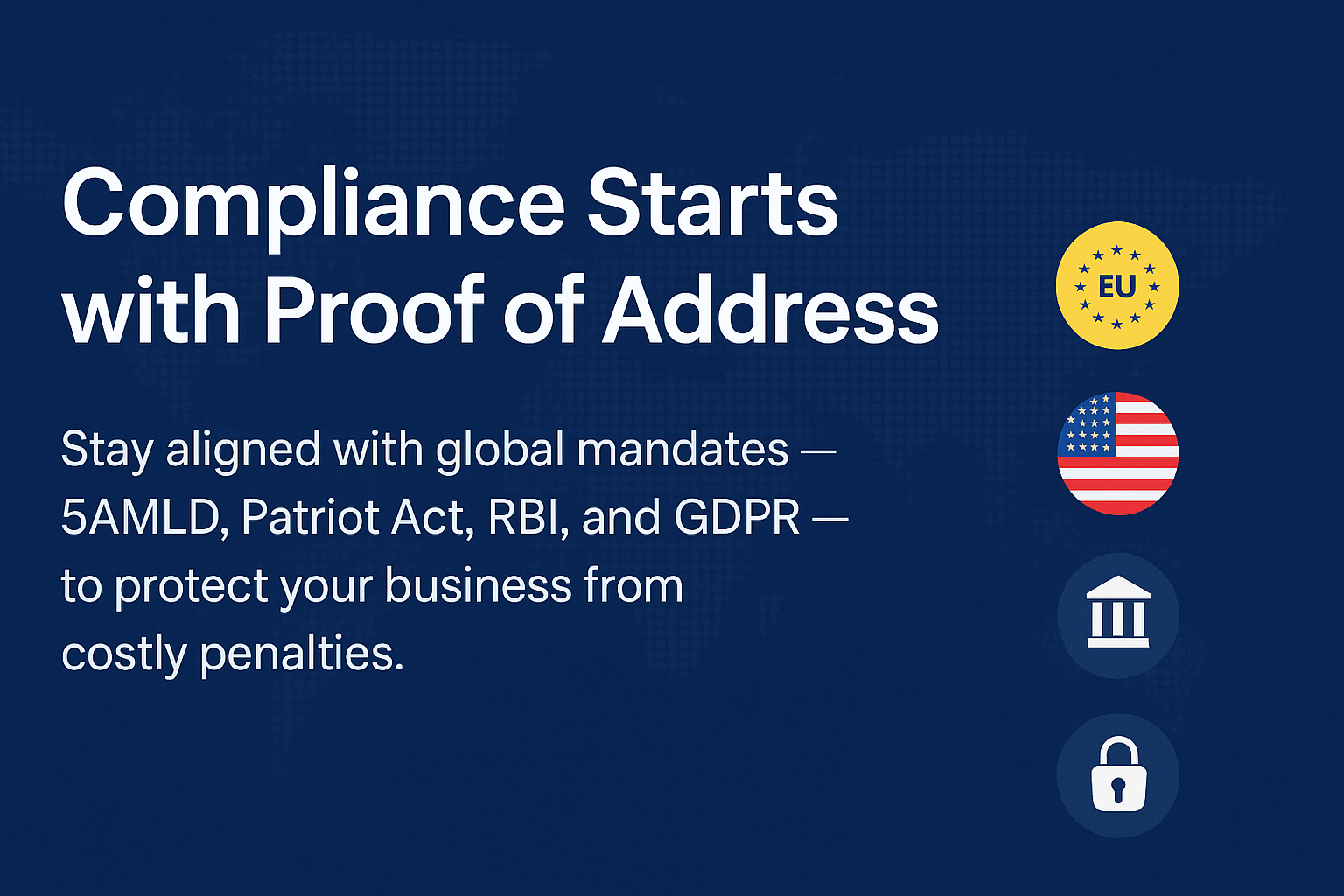
- KYC/AML and CIP frameworks: Proof of residence mandated by regulators such as FINRA (U.S.), FCA (U.K.), RBI (India), and under EU’s AMLD and GDPR
- The Fifth EU Anti-Money Laundering Directive (5AMLD): Mandates address verification as part of customer due diligence.
- The USA Patriot Act CIP Rule 326: Directs financial institutions to collect and verify customers’ names, addresses, birthdates, and other identifying information.
Non-compliance can lead to severe penalties — in 2023 alone, fintech and crypto firms paid over $5.8 billion in AML-related fines.rrof
Types Of Address Verification
By definition, Address Verification (AV) is the process of making sure that a postal address, furnished by a user at the time of onboarding/signing up, is accurate and verifiable. The address is typically verified against trusted government data sources such as the electoral roll or the postal authority’s database.
There are different types of address verifications:
Document-based proof of address
Regulator approved documents, such as utility bills, government IDs, bank statements, etc., are widely used for address verification or AV. To combat fraud, many issuers now embed QR codes within these documents, enabling AV engineers to extract data and validate their authenticity efficiently.
eID and authoritative‑database lookups
Real-time queries are sent to credit bureaus, tax authorities, and national ID registries to verify the existence of a document. The response time is under two seconds, facilitating real-time verification.
Dynamic Proof of Possession (D-PoP)
Platforms like crypto exchanges, while onboarding customers, ask them to film a short selfie holding the proof of address. The address verification system can cross-check GPS coordinates, timestamps, and document barcodes to ensure the existence of an address and a customer.
Biometric and address credential linkage
This emerging model ensures persistent compliance by linking verified address credentials to a user’s digital identity wallet. By combining biometric authentication with identity verification and address verification, organizations can create a secure, tamper-proof identity framework that strengthens trust, enhances compliance, and simplifies future verifications.
Common Pitfalls In Address Verification
Many oversights lead to address verification failures. Common pitfalls include accepting expired proof documents, relying on outdated databases, over-reliance on self-declared inputs, misformatted addresses, and improper handling of data or privacy protocols.
Best Practices for Address Verification
Building an effective address verification (AV) process requires precision, consistency, and compliance. The following best practices help organizations strengthen their verification framework while improving customer experience.
Multi-Layered Verification
Cross-validate addresses against trusted IDs such as passports, driver’s licenses, utility bills, or postal records. This layered approach enhances accuracy and prevents fraudulent submissions.
Adopt Automation
Use technologies such as Optical Character Recognition (OCR), liveness detection, and geolocation validation to streamline and scale verification.
In fact, automation can reduce onboarding time by 40–60% while strengthening compliance and improving user experience.
Address Standardization
Standardizing addresses helps eliminate format errors such as unit numbers and ZIP variations. Adopt Universal Postal Union (UPU) formats and ISO 19160-1 standards for data quality and postal accuracy.
Tiered Risk-Based Approach
Set up risk score-based tiering using geography, transaction value, and customer profile to apply the right level of scrutiny.
A tiered approach ensures alignment with FATF Recommendations and global Risk-Based KYC frameworks.
Maintain a Compliance Trail and Regular Audits
Track and log every verification step, including data source, validation method, and timestamp. Maintaining an auditable trail safeguards against disputes and simplifies regulatory reporting.
Conduct regular audits and continuous staff training to sustain compliance and operational integrity. Continuous auditing not only ensures compliance but also builds regulator confidence during inspections or reviews.
Address Verification: The Foundational Trust Signal
In an age of rising digital fraud and heightened global oversight, address verification is more than an operational requirement — it’s a strategic trust anchor. Regulators are enforcing stricter KYC/AML laws, and ensuring compliance is now fundamental to customer trust and business resilience.
With real-time verification and validation tools, organizations can strengthen compliance, enhance onboarding, and protect customer data integrity. By embracing robust verification processes, businesses achieve faster onboarding, fewer drop-offs, stronger resilience, and higher customer satisfaction — all while staying compliant.
Discover how Melissa’s global address verification solutions help organizations meet KYC/AML standards while ensuring data accuracy and customer trust.