Every year, criminals launder between 2 to 5% of the global GDP. That’s as much as EUR 1.87 trillion annually! This gets used to finance serious crime as well as terrorism. It’s no wonder businesses are stressing on Anti-Money Laundering (AML) screening measures. Complying with AML regulations protects brand reputations and safeguards against financial fraud. This article talks about 7 strategies that can enhance AML watchlist screening.
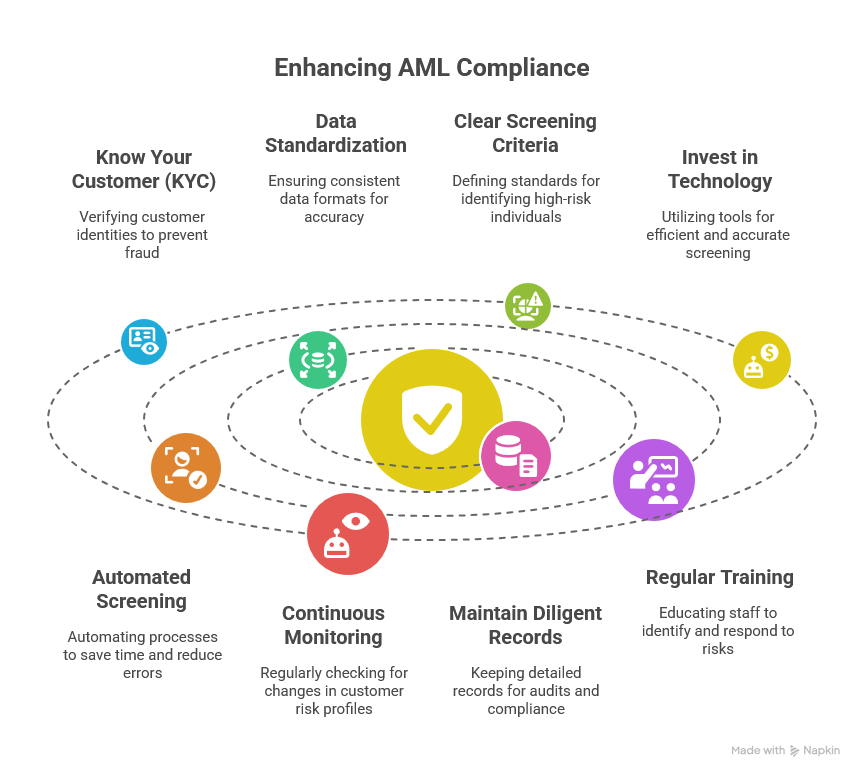
1. Know Your Customer (KYC)
A large percentage of financial transactions take place online with businesses never meeting their customers. Hence, it is more important than ever to confirm customer identities and ensure that they are who they claim to be.
It’s a simple process that involves collecting proof of identification from the customer and verifying the same before onboarding a new customer. This can be done by comparing the document to data stored in reliable third-party servers. Rather than verify each identity manually, the process can be automated with identity verification tools.
2. Data Standardization
Data standardization refers to ensuring that all data entering the database is maintained in a consistent format. For example, all customers must have a first name and a last name, and phone numbers must be stored with the area code. Standardization begins with maintaining a common form for data entry across all sources. Many verification tools also have features that allow them to parse data and structure it according to a standardized format.
This makes data easier to compare and reduces the risk of having duplicate records on file. In turn, this makes the screening process more accurate and reduces the risk of false matches and human error.
3. Clear Screening Criteria
In addition to KYC, customer identities must be screened against databases such as global watchlists and sanctions lists as well as Politically Exposed Persons (PEPs). You may also screen identities for adverse media mentions and other associations that suggest a higher risk of involvement in financial crime. Standardizing the screening criteria ensures that fraudsters do not slip through the cracks and makes compliance easier.
Once a screening criterion has been defined, it is essential to stay updated with regulatory changes and sanctions lists. Many businesses establish a dedicated compliance officer or a team to monitor and respond to these updates.
4. Invest in Technology
Leveraging technology for AML screening has many benefits. It streamlines the process, reduces manual efforts, and supports documentation. Technology can be put to use in many different ways. Automation is the starting point. You can also invest in Machine Learning and Artificial Intelligence powered tools to screen customer profiles.
These tools not only have higher accuracy ratings but can be used to monitor transactions in real time while ensuring ongoing due diligence. Similarly, investing in data analytics tools makes it easier to identify trends and patterns in financial transactions.
5. Automated Screening
Like KYC verification, watchlist screening can also be automated. This saves time, is more accurate, and eliminates the risk of human bias. Similarly, ongoing transactions can also be automatically screened for anomalies. For example, let’s say a customer usually limits online transactions to under EUR 500 but there is a sudden transaction for EUR 1200. This automated screening tool may flag such transactions for further due diligence.
6. Continuous Monitoring
Verifying customer identities when onboarding a new customer is only the first step of AML compliance. A lot can change with time. The customer may live in a region that suddenly becomes a target for money launderers. Or, the customer’s identity may be stolen and misused by a fraudster.
The only way to combat this is by continuously monitoring online activity. Many identity verification tools used for initial KYC checks can also be set up to run batch-validation tests on customer data existing in your database. This helps fight against data decay and ensures up-to-date compliance.
7. Maintain Diligent Records
Even with automated systems, it is essential to maintain records of all system alerts. If the system raises too few or too many red flags, you may need to relook at the screening criteria to ensure it isn’t raising false positives. This effort goes a long way to avoid making mistakes like blocking transactions by mistake. While this may seem like a minor inconvenience, it can dampen the overall customer experience and affect your brand reputation.
Record keeping also helps with audits. Interestingly, almost 10% of global AML events are compliance failures. Failing to document your findings properly could not only make compliance harder but may also put you at risk of heavy financial penalties. In 2021, HSBC was fined $85 million for failing to maintain proper AML records.
8. Regular Training
An AML screening program can only be as effective as the team that runs it. If the team is well-informed and trained, they can spot easily anomalies and potential risks. This holds true even when screening is automated. A certain degree of manual overwatch is always required to keep false positives at bay and ensure ethical compliance.
Your compliance teams should understand how the screening process works and how to respond to different types of alerts. They should also have a clear understanding of the degree of risk represented by different alerts, when issues need to be escalated, and to whom.
Conclusion: A Holistic Approach to AML Screening
From fintech platforms and eCommerce businesses to traditional banks, organizations across industries are prime targets for money laundering. Criminals often exploit vulnerabilities through fake identities, fragmented transactions, or outdated systems—making comprehensive AML watchlist screening solutions an operational necessity.
To fight financial crime effectively, businesses must:
- Implement KYC and watchlist screening at the start
- Automate processes for speed and scalability
- Validate and standardize customer data
- Monitor changes and log activities continuously
AML compliance isn’t a one-time checkbox—it’s an ongoing, adaptive process. With the right tools and a risk-based AML approach, businesses can protect customers, reduce fraud exposure, and minimize the risk of costly penalties.