Cold emailing is still one of the most widely used modern outreach and marketing tools. But isn’t it illegal to send cold unsolicited emails to prospects? Won’t watchdogs mark it as spam and fine your organization?
Not necessarily. Cold emailing isn’t illegal—as long as you follow the rules. Each country sets its own compliance requirements. This article breaks down the major regulations, including the U.S. CAN-SPAM Act, Canada’s CASL, Europe’s GDPR, Australia’s Spam Act, Hong Kong’s PDPO, and Singapore’s PDPA.
The Global Landscape of Cold Email Regulations
The global regulatory landscape focuses on three key compliance areas when it comes to email and other marketing messaging:
- Transparency about the sender’s identity and intent of the message
- Easily accessible opt-out or unsubscribe options
- Targeted messaging instead of mass emails
Adhering to compliance is key to building trust, avoiding fines, and improving deliverability. Let’s explore the global laws and regulations around electronic marketing messages in detail.
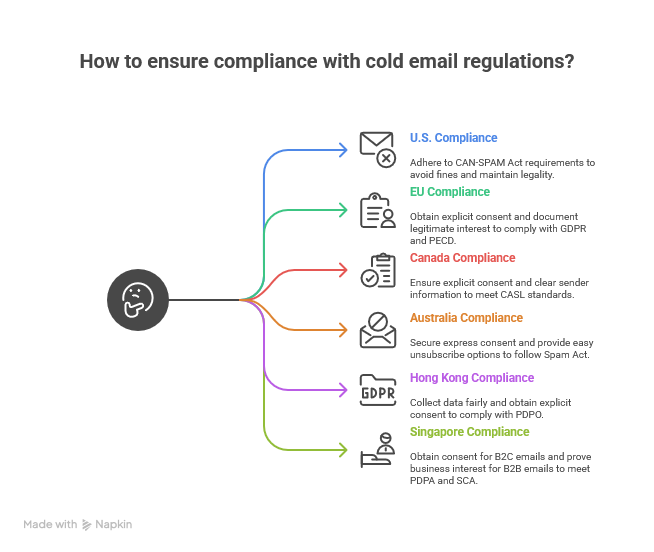
United States – CAN-SPAM Act
The CAN-SPAM Act of 2003 (Controlling the Assault of Non-Solicited Pornography and Marketing) was set in place to make sure that email marketers:
- Use clear subject lines or headers
- Use clear identification of the intent of the message
- Add a valid U.S postal address that can be verified using government and third-party databases
- Incorporate a functional unsubscribe link to messages
Even if the marketing agency you hire commits any violation while sending your cold emails, your organization could be held legally liable. Violations can attract hefty fines or criminal penalties, depending on the severity.
In addition to the CAN-SPAM Act, states like California (CPRA/CCPA), Colorado, and Virginia have additional regulations regarding the use of personal data in marketing messages.
Key takeaway: Cold emailing is legal in the U.S. as long as it is dispatched in line with the law.
European Union – GDPR And PECD
Are cold emails legal in the EU region? There is no one-word answer to that. GDPR and Electronic Communications Directive 2002 (PECD) or ePrivacy Directive determine if your cold emails are legal or not based on the below criteria:
- Explicit opt-in consent, especially for B2C messages
- A formally documented legitimate interest for B2B emails with a clear opt-out link
Violations of the regulations can lead to fines of up to €20 million or 4% of global annual turnover. To avoid any legal obligations, stay vigilant, train your staff, and review your policies periodically.
Key takeaway: Make sure that your sender list is updated based on consent and that the cold emails meet opt-out requirements in the EU.
Canada - Canada’s Anti-Spam Legislation (CASL)
Regarding cold emails and other Commercial Electronic Messages (CEMs), Canada has strict rules and regulations in place. Under Canada’s Anti-Spam Legislation (CASL), for cold emails or any such electronic marketing communication, the below points are non-negotiables:
- Consent: Express or explicit consent can be attained using unchecked opt-in boxes or signed agreements. Implied consent applies in cases of existing business relations or publicly published contact info.
- Sender information: Every cold email and other such marketing communication must contain clear sender identification such as email ID, name, and address.
- A functional unsubscribe option: An easy-to-use unsubscribe option must be added to all cold emails.
(CRTC) Canadian Radio-television and Telecommunications Commission has been enforcing CASL regulations strictly. The authority has received over 208,083 spam complaints during the period between October 1, 2024, and March 31, 2025 alone.
Key Takeaway: Cold emails without explicit consent in Canada are high-risk, and violations can result in penalties. So, ensure that your marketing communications are consent-based.
Australia – Spam Act
According to Australia’s Spam Act 2003, cold emails and other commercial electronic messages (CEMs) are legal as long as they don’t violate the below rules:
- Consent: Express user consent attained via opt-ins or checkboxes. Inferred consent is acceptable only if the message is related to a recent purchase. It is important to note that the burden to prove the relationship with the receiver is on the sender.
- Identification of the sender: Each mail should contain sender information such as your business name and contact details.
- A Functional unsubscribe option: The unsubscribe option has to be easy to find and use
The country is serious about their rules, and the Australian Communications and Media Authority (ACMA) has collected more than AU$14 million in spam-related penalties between 2023 and 2025.
Key Takeaway: Cold emails or any unsolicited commercial messages sent without proper consent and clear identification can put your business on the back foot.
Hong Kong – PDPO (Personal Data (Privacy) Ordinance)
Cold emailing is allowed in Hong Kong only when you collect user data fairly and lawfully, and use it only for the collected purpose. The country has PDPO (Personal Data (Privacy) Ordinance) in place to make sure that personal data is collected fairly and squarely. Under the PDPO:
- Explicit user consent is required to send cold emails
- Users should be notified about their right to opt out
- User data should not be transferred to third parties without consent
Key Takeaway: Cold emailing without explicit user consent could land your company in trouble and attract hefty fines. Failure to comply with the regulations can lead to a fine of HK$1 million.
Singapore – PDPA And Spam Control Act
Cold emailing and other such marketing messages in Singapore come under the PDPA (Personal Data Protection Act. Compared to other countries, Singapore has some grey areas when it comes to cold emails, however, while sending marketing mail, adhering to the below guidelines are advisable:
- Sending emails with a clear subject line
- Adding clear sender information including email ID and a working physical address
- Using a functional unsubscribe option
Sending B2C emails without consent is almost always a violation of PDPA regulations. However, you can send promotional emails to B2B customers if you can prove business interest or prior contact, even if you don’t have documented consent.
Even though emails sent to generic corporate accounts such as info@company.com are generally outside PDPA’s scope, SCA regulations can come into play.
Key takeaway: It is always better to obtain consent while sending cold emails to B2C contacts. However, in B2B scenarios, cold emailing may be acceptable.
A Snapshot of Global Regulations Surrounding Cold Emails
|
Region
|
Consent Required?
|
B2B Allowed?
|
|
U.S.
|
No
|
Yes (compliance)
|
|
EU
|
Yes / Legitimate Interest
|
B2B possible under L.I.
|
|
Canada
|
Yes
|
Only with consent
|
|
Australia
|
Yes
|
Risky without consent
|
|
Hong Kong
|
Yes (data fairness)
|
Only with lawful basis
|
|
Singapore
|
Yes
|
Allowed
|
How to Stay Cold Email Compliant
Cold emailing isn’t dead—in fact, it remains one of the most profitable outreach tools, delivering up to $36 in revenue for every $1 spent. But success comes only when you play by the rules.
By keeping your lists clean, following global regulations, and using technologies like email validation, you can boost deliverability, protect your reputation, and build real trust with your audience.
Stay compliant. Respect your prospects. And make every cold email count.
Start with verified email lists for safer outreach—get 100 FREE credits today.