Digital revolution has undoubtedly helped modern businesses to reach out to more customers as well as unlock valuable insights about their needs, habits, and preferences. However, the same revolution has enabled scammers and hackers to create and abuse fake accounts for committing frauds and stealing data and money.
In fact, in 2023, after purchasing a platform for college financial assistance, JPMorgan Chase realized that only 300,000 out of 4.25 million customer accounts were legit. Customer validation can go a long way in identifying and preventing such scenarios though.
Through this technique, you can not only verify the name of a customer, but also their device, contact number, address, and email ID in seconds. Each data point captured is tested against a wide array of reliable data sources to ensure the genuineness and correctness of every customer. Let’s understand the key aspects of customer validation and more for your business’s security.
Customer Data Validation: Key Aspects
Validating customer data helps you to ensure that a customer is who they say they are. And the process generally involves these key steps:
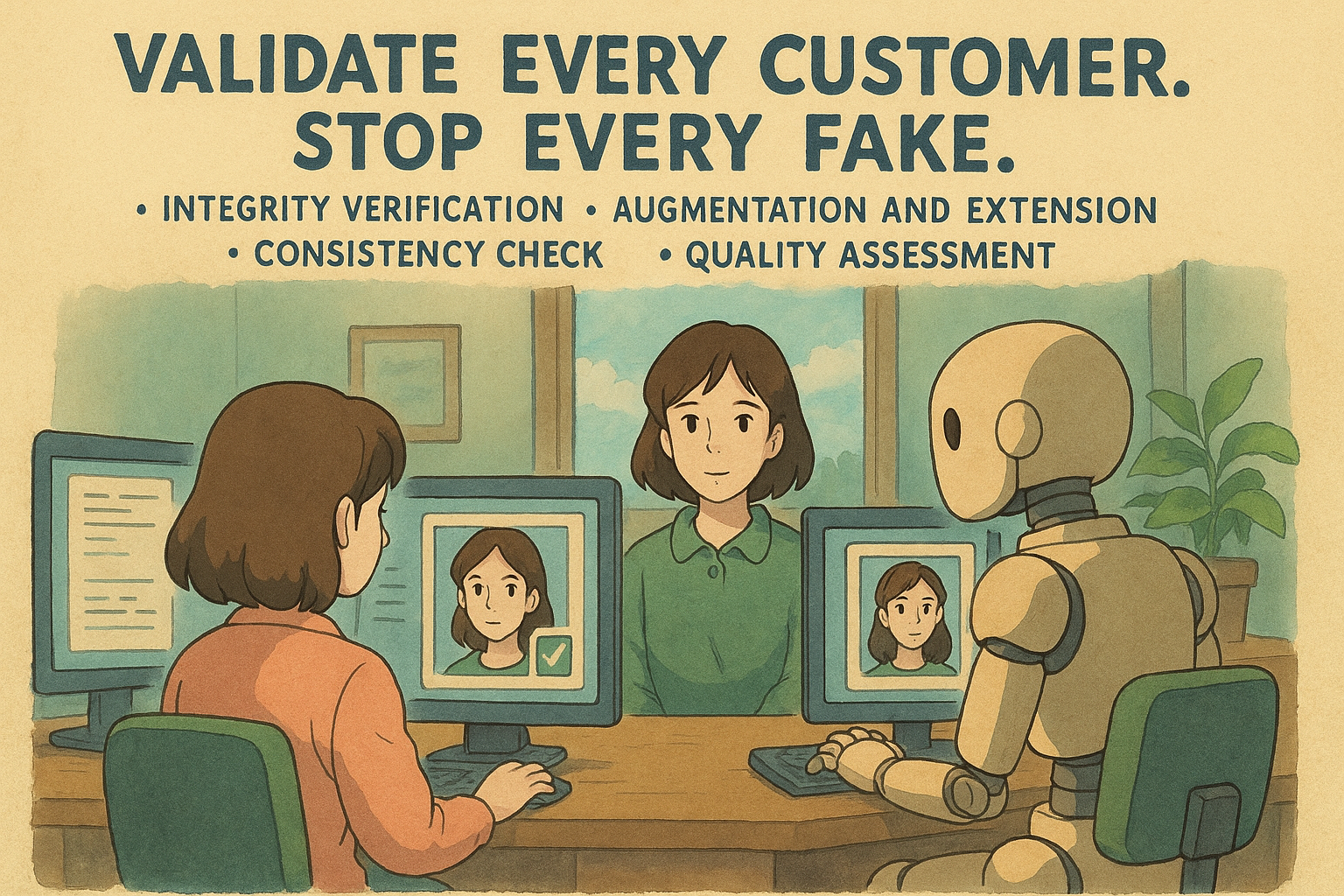
This step is all about checking every core data point against dependable and global sources of data in real time. This way, you can rest assured that you have the correct details to begin with.
- Augmentation and Extension
The customer record is augmented with extra but crucial information in this step. Additional data points might include geographical address, IP address, phone number, email ID and its status, etc. These details aid businesses in deciding whether the records collected are of poor or decent quality.
The third step connects the core data points with the ones derived in the step above. Thorough cross-checking between the two sets of data helps in determining consistency.
The last step involves zeroing in on the overall precision and quality of a customer’s records. Every element of a record receives a quality score that is numeric and the record itself is assigned a confidence score. This is the stage where it becomes easy for you to spot and eliminate customer accounts that seem high-risk or suspicious.
Validation Services for Preventing Fake Accounts
Now that you know about the importance and chief aspects of customer data validation, let’s look into the services that fight against fake accounts.
For Name
The name validation service is about analyzing, formatting, and gauging accuracy at the entry point. It organizes the data into the right fields automatically besides eliminating anything that is not required. The validation process also sheds light on names that are fake or bogus. The verification filters used for the purpose often include consumers or businesses, nicknames, vulgar words, and celebrity names. Names are also filtered based on origin, syntax, phonetics, and so on.
For Address
Addresses that are incorrect or not complete can cost your business in terms of failed or missed communications. Shipping products to wrong locations can also translate to hefty financial losses. Hence, addresses are among the common parameters that indicate if an account is false or not. And fortunately, advanced address validation techniques are capable of verifying and rectifying addresses across hundreds of countries. This caters to the needs of businesses of all sizes. Moreover, the service is usually scalable, so it can grow and evolve with your business.
For Phone Number
When it comes to validating customer data, phone number validation plays an integral role in ensuring the realness and accuracy of accounts. And cutting-edge validation techniques can delve into minute details about where the phone number has been as well as who used it and how. Businesses can derive insights such as:
- Names of current and past users
- Address used for mailing
- Geographical coordinates of the address
- Type of phone (residential or commercial)
- Type of line, like landline, wireless, VOIP, etc.
- History of number porting
For Email
Fraudsters tend to leverage free email accounts such as Outlook, Gmail, and Yahoo as these can be set up conveniently and also offer anonymity. Which is why, avant-garde email validation services use a whole host of filters and conduct numerous checks to obtain insights into an email ID’s risk status. The verification technique also flags email addresses that are vulgar, bogus, or known for spams. It checks if mails can be delivered without any hiccup to the stated IDs as well.
For Device
The best-in-class device validation techniques have access to billions of IP addresses along with their reputation. This makes it easy for the validation service to determine the type of device, its location, as well as any proxy servers. The IP addresses are also cross-referenced against the addresses provided for shipping and billing, to detect transactions that are risky or fraudulent. IP validation service has another key advantage too. When you are sure about the accuracy of a customer’s location, it is easy to define sales regions and design targeted campaigns for marketing.
Protect Your Business Efficiently with Customer Data Validation
Did you know that in 2022, ecommerce fraud at a global level led to a staggering loss of around $41 million? And since fake accounts are often the channel for fraudsters to make illegal transactions or abuse membership benefits, it is necessary to nip the issue in the bud. This is the reason why embracing customer data validation as your primary defense against malicious attacks makes sense.
By leveraging intelligent techniques for verifying major details like name, address, email ID, contact number, and IP address, you can ensure the quality and accuracy of a customer account. It can not only prevent financial drain, but also strengthen your marketing strategy through informed targeting. You will also be able to adhere to regulatory standards, earn the trust of authentic customers, and secure your reputation among multiple stakeholders.
Book a Demo — See How Melissa’s Customer Data Validation Stops Fake Accounts Instantly.