Artificial intelligence is having a moment. Walk into any supply chain conference, and you will hear about predictive analytics, autonomous logistics, and generative AI transforming procurement. Boardrooms are buzzing with questions about AI roadmaps. Vendors are racing to add “AI-powered” to every product label.
Amid all this excitement, a quieter but more important truth is being overlooked: AI does not fix bad data. It magnifies it.
For supply chain leaders, the allure of AI is understandable. Margins are under pressure. Disruptions are constant. Customer expectations are higher than ever. The promise of smarter, faster, more autonomous operations is deeply seductive.
But pursuing AI before mastering data quality is a strategic mistake that wastes capital, erodes trust, and ultimately leaves organizations worse off than when they started.
The High Cost of Skipping the Data Foundation
Consider two companies.
Company A invests $5 million in an AI-powered demand forecasting platform. The algorithms are sophisticated. The implementation team is top tier. But the underlying data, including vendor addresses, warehouse locations, and historical shipment records, is riddled with errors. Addresses are inconsistently formatted across regions. Duplicate vendor records confuse sourcing decisions. Inventory location data has not been audited in years.
The AI model does exactly what it is designed to do. It learns from the data it is given. It identifies patterns in the noise and generates forecasts that are precise but wrong. Because the outputs are treated as authoritative, the organization doubles down on bad decisions. The $5 million investment does not just fail to deliver ROI; it actively damages operational performance.
Company B takes a different approach. Before investing in AI, they invest in data quality. They implement address verification across all vendor onboarding and customer delivery systems. They standardize location data across their ERP, warehouse management, and transportation platforms. They establish governance processes to maintain data accuracy over time.
When they eventually deploy AI, the results are dramatically different. Clean, standardized data enables faster implementation. Models train more efficiently and generalize more accurately. The organization captures value not just from AI, but from the operational efficiencies unlocked by data quality alone.
Company B is not hypothetical. It represents the organizations that understand a fundamental truth: data quality is not a prerequisite for AI—it is a strategic asset that delivers value with or without AI.
Clean Data Delivers Value Today
AI promises future transformation. Clean data delivers measurable value today, something every CFO understands.
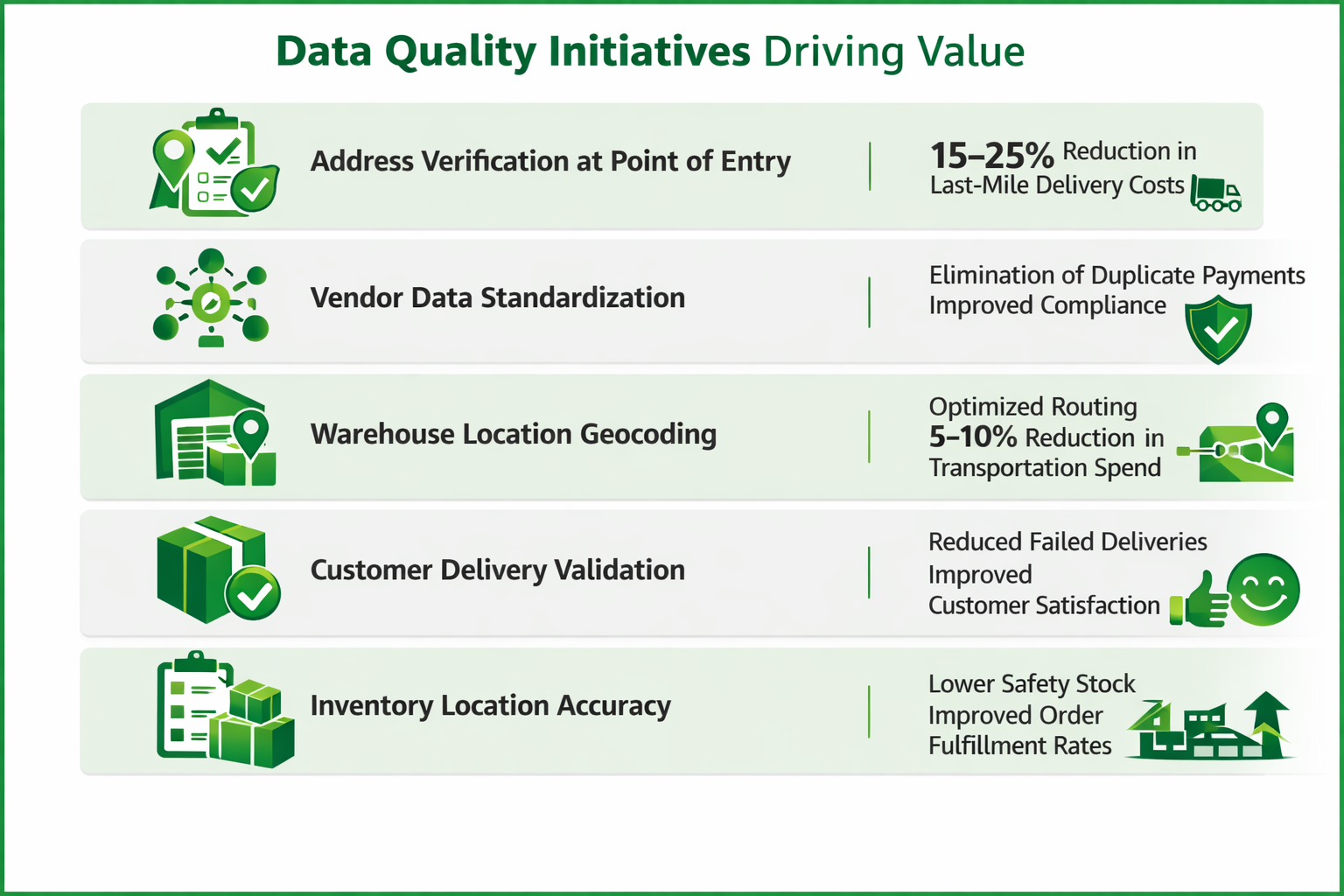
These are not speculative benefits. They are achievable within weeks or months, with clear ROI calculations that do not depend on complex algorithms or lengthy implementation timelines.
AI, by contrast, requires significant investment in infrastructure, talent, and change management before delivering any return. And even then, its success hinges entirely on the quality of the data it consumes.
The Trust Imperative
Beyond operational efficiency, clean data addresses a more fundamental business requirement: trust.
When your logistics dashboard reports on-time delivery rates, can you defend those numbers to a customer? When your sustainability report claims reduced carbon emissions, is the underlying location data accurate enough to support that claim? When your procurement system flags a compliance risk, do you trust the vendor records that triggered the alert?
In an era of increased regulatory scrutiny and customer demand for transparency, trust is not a soft concept. It is a competitive differentiator. And trust begins with data that is accurate, complete, and reliable.
AI cannot create trust. It can only reflect the trustworthiness of the data it is given.
Clean Data Reduces Risk
Supply chains are networks of dependencies. A single bad data point can cascade into significant operational failure:
- An incorrect vendor address delays a critical component shipment, halting production.
- A mismatched identifier routes a payment to the wrong entity, triggering compliance violations.
- An outdated warehouse geocode sends a truck to the wrong city, missing a customer delivery window.
- A missing suite number causes repeated failed delivery attempts, driving up costs and damaging customer relationships.
These risks are not theoretical. They are daily realities for organizations that treat data quality as a technical issue rather than a strategic priority.
Organizations that invest in data quality build resilience. They know where their inventory is. They know which vendors are active and compliant. They can pivot quickly when disruptions occur because their operational foundation is solid.
AI Without Clean Data Is a Liability
The most dangerous aspect of the current AI hype cycle is not the technology itself—it is the assumption that AI can somehow overcome poor data quality.
This assumption is wrong.
Machine learning models are pattern-matching engines. They do not possess judgment. They cannot distinguish between a genuine signal and a data-entry error. When trained on bad data, they produce outputs that are confidently incorrect. And because AI outputs are often treated as more authoritative than human intuition, bad decisions are executed at scale and at speed.
AI without clean data is not a competitive advantage. It is an accelerator of operational failure.
A Strategic Path Forward
For supply chain leaders, the question is not whether to invest in AI. The competitive landscape will demand it. The question is when and how—and what must come first.
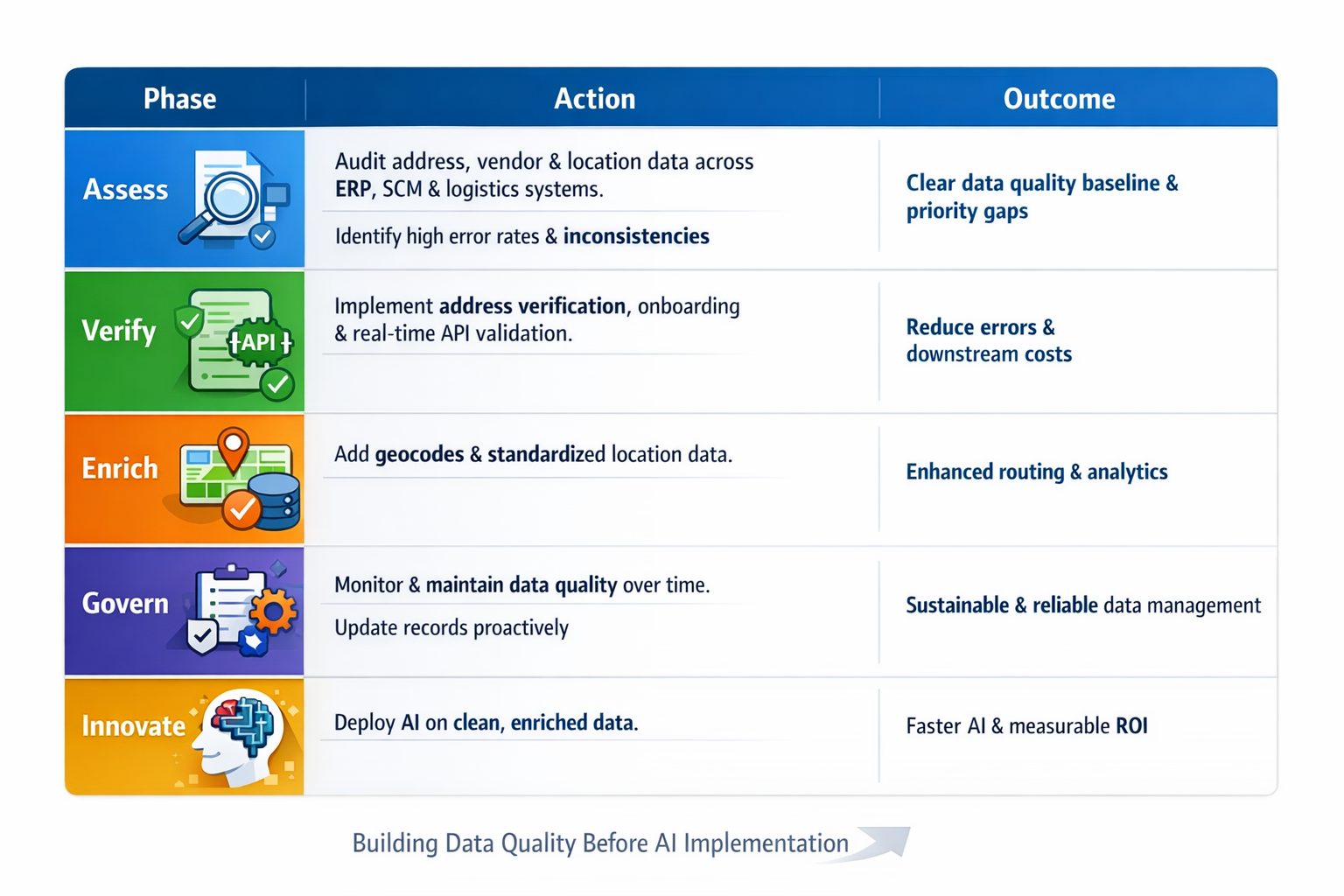
Here is a practical framework for prioritizing data quality before AI:
Conclusion
Before you ask “What’s our AI strategy?” ask a more fundamental question: “Is our data ready?”
If the answer is no, and for most organizations it is, then the smartest investment you can make today is not in algorithms. It is in the data quality foundation that will determine whether those algorithms succeed or fail.
Clean data is not a prerequisite for AI. It is a strategic advantage that delivers value now and multiplies the returns of every future technology investment.
See how better data quality can transform your supply chain. Request a demo today: Click here