In today’s AI-driven landscape, data quality has evolved from a technical hygiene task into a core strategic business asset. While organizations have long recognized the importance of clean data, a profound shift is underway. We are moving beyond reactive data cleaning toward intelligent, proactive systems that anticipate issues, enforce governance by design, and unlock measurable business value.
The question is no longer “Is our data accurate?”
It is now “Is our data intelligent, ethical, and delivering competitive advantage?”
The stakes have never been higher. With the global data sphere projected to exceed 200 zettabytes and AI embedded across decision-making, poor data quality no longer just produces flawed reports. It leads to misguided AI outcomes, regulatory exposure, operational inefficiencies, and erosion of customer trust.
This blog explores the six defining data quality trends that will shape data excellence through 2026 and beyond.
The 6 Defining Data Quality Trends for 2026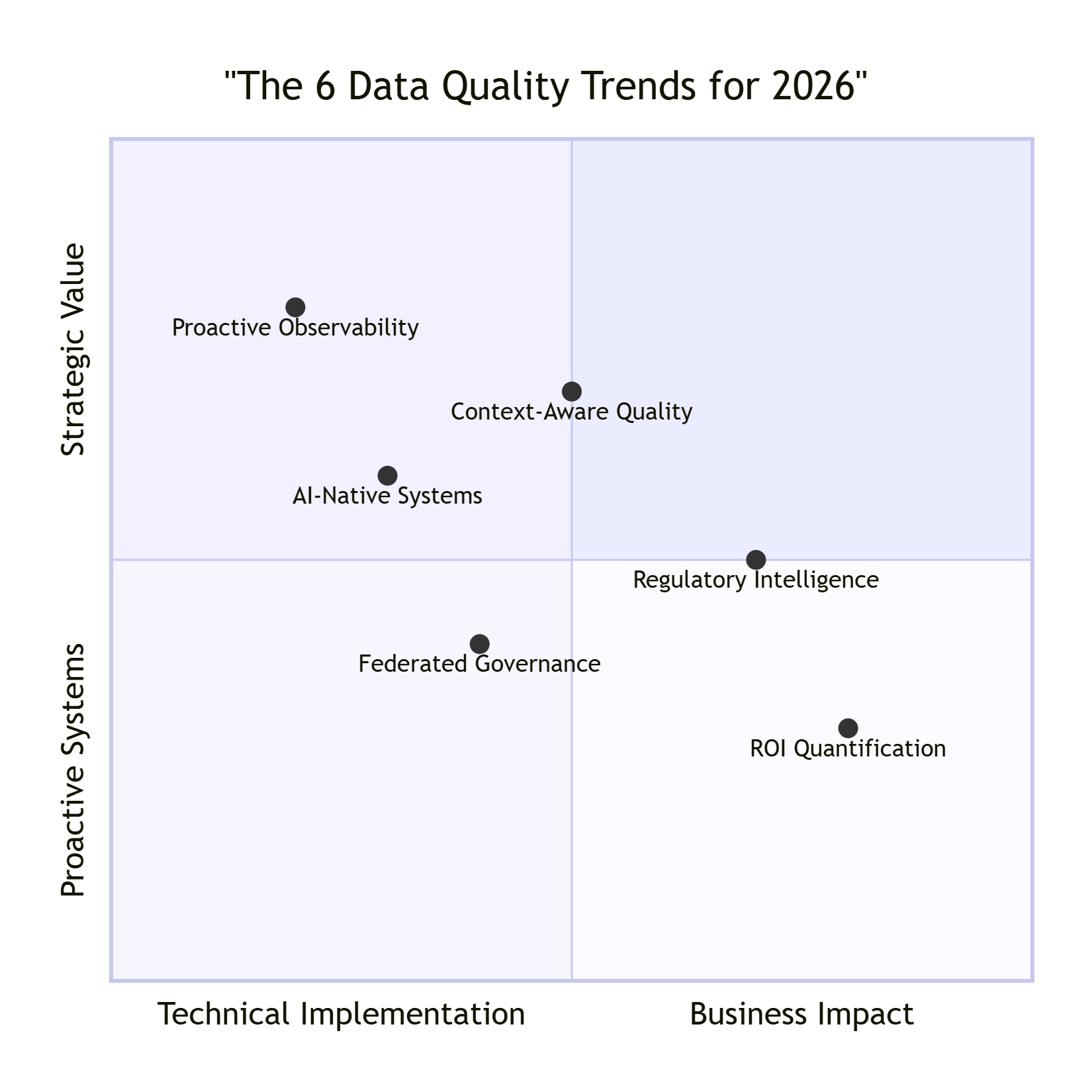
1. Proactive Data Observability (Beyond Reactive Monitoring)
Traditional data quality approaches rely on detecting issues after they have already impacted downstream systems. This reactive model is rapidly becoming obsolete.
Proactive data observability represents the next evolution. These systems continuously monitor data pipelines, diagnose anomalies, and often self-heal issues before they disrupt analytics, AI models, or business operations.
By shifting quality checks “left” into data creation and ingestion stages, observability platforms use machine learning to establish baseline behavior and flag deviations in:
- Data freshness
- Volume and distribution
- Schema changes
- Lineage integrity
Financial services organizations adopting proactive observability report up to a 70% reduction in downstream data incidents and a 40% faster time-to-detection for emerging quality risks.
Why it matters: Reliable data pipelines are foundational to trustworthy AI and uninterrupted decision-making.
2. Context-Aware Data Quality (The Intelligence Layer)
Traditional data quality rules operate in isolation—validating formats, ranges, or completeness without understanding how data is actually used.
Context-aware data quality introduces an intelligence layer that understands business meaning and usage patterns, enabling smarter prioritization and governance.
This approach incorporates:
- Usage patterns: Identifying which teams rely on which data for critical decisions
- Temporal intelligence: Understanding seasonality, lifecycle changes, and business cycles
- Relationship mapping: Connecting related data elements across domains
- Business impact scoring: Prioritizing quality controls based on potential operational or financial impact
For example, a retail organization may enforce stricter validation on inventory and pricing data during peak holiday periods, while relaxing controls during off-peak cycles to optimize resources.
Why it matters: Data quality efforts align directly with business impact—not arbitrary rules.
3. Federated Data Mesh Governance (Decentralized Quality)
As data ecosystems scale, centralized governance models increasingly become bottlenecks. Federated data mesh governance addresses this challenge by distributing data ownership to domain experts while preserving enterprise-wide standards.
In this model:
- Marketing teams govern campaign and customer engagement data
- Supply chain teams own logistics and inventory datasets
- Finance teams manage transactional and reporting data
All domains adhere to shared standards for security, metadata, interoperability, and compliance through federated governance frameworks.
Organizations implementing data mesh governance report 50% faster data product development while maintaining over 95% compliance with enterprise policies.
Why it matters: Decentralization accelerates innovation—without sacrificing consistency or control.
4. AI-Native Data Quality (The Symbiotic Relationship)
As AI increasingly drives business decisions, data quality frameworks are becoming AI-native by design. This creates a symbiotic relationship between AI systems and data quality processes.
This operates in two directions:
- AI-for-Quality: Machine learning automates profiling, anomaly detection, and dynamic rule generation
- Quality-for-AI: Specialized quality controls ensure reliable training data, model inputs, and AI-generated outputs
A critical emerging area is synthetic data validation. As organizations use synthetic data to protect privacy and scale AI training, new frameworks ensure statistical fidelity and bias control.
Forward-looking enterprises are appointing AI Data Stewards—roles dedicated to ensuring ethical, reliable, and high-quality data flows into and out of AI systems.
Why it matters: High-quality AI is impossible without AI-aware data quality.
5. Regulatory Intelligence Integration (Compliance by Design)
With global regulations expanding—from GDPR to emerging AI governance frameworks—compliance can no longer be an afterthought.
Regulatory intelligence integration embeds compliance directly into data quality processes through automated policy enforcement.
Modern platforms now support:
- Geographic awareness: Applying region-specific rules based on data origin and usage
- Dynamic policy engines: Automatically updating rules as regulations evolve
- Automated audit documentation: Generating compliance evidence on demand
- Privacy-utility optimization: Balancing data protection with analytical value
Leading organizations are moving toward continuous compliance certification, where data products prove regulatory adherence through embedded metadata and quality metrics.
Why it matters: Compliance becomes scalable, auditable, and proactive—rather than reactive and manual.
6. Data Quality ROI Quantification (From Cost to Value Center)
Historically, data quality initiatives were viewed as necessary costs with difficult-to-measure returns. That perception is rapidly changing.
Advanced ROI quantification frameworks now directly link data quality investments to business outcomes by tracking:
- Decision confidence scores: Measuring trust in analytics and AI outputs
- Process efficiency gains: Quantifying time saved through automation
- Risk reduction valuation: Estimating avoided compliance penalties or decision errors
- Opportunity enablement: Revenue generated from new use cases enabled by trusted data
Organizations using these frameworks report securing 2–3x higher investment in data quality by clearly demonstrating its financial impact to executive leadership.
Why it matters: Data quality is finally recognized as a revenue enabler—not just risk mitigation.
Conclusion: The Competitive Advantage of Intelligent Data
The shift from reactive data cleaning to proactive, intelligent data quality is more than a technological upgrade—it is a fundamental redefinition of data’s role in organizational success.
As we move through 2026, the organizations that lead will be those that treat data quality as a strategic capability, not an IT initiative. From observability and AI-native frameworks to federated governance and ROI measurement, these trends point to a future where data quality is embedded, invisible, and continuously delivering value.
It quietly ensures that every AI recommendation, every regulatory decision, and every customer interaction is built on trusted, contextual, and ethical data.
Begin by addressing one critical challenge within your organization. Launch a focused pilot, demonstrate measurable value, and expand systematically. In the data-driven economy of 2026 and beyond, success will not be defined by the problems you avoid—but by the opportunities your data enables.
Talk to our address experts to explore how high-quality, verified address data can become a strategic foundation for trusted analytics, compliant operations, and AI-ready data ecosystems—book a demo.