Organizations across the UAE are moving from experimenting with AI to putting it to work. The UAE government has announced a framework to transition 50% of government sectors, services and operations to agentic AI within two years. The initiative signals the country’s commitment to moving beyond AI experimentation toward systems that can execute tasks and support decisions autonomously.
Most of the conversation focuses on what agents can do and how to govern them. Less attention goes to AI data quality: the customer data agents read, match and act upon. An agent working from inaccurate records does not simply give a poor answer. It may take a poor action.
Why Agentic AI Depends on Data Quality
Unlike a basic conversational system that primarily responds to user prompts, an AI agent can be configured to pursue a goal through multiple steps, retrieve information, use connected business applications and initiate actions within its assigned permissions. This changes the consequences of poor data quality.
If a system cites an outdated address, a person can usually notice and correct it. If an agent acts on that address, the error can move into a letter, a delivery, a payment reminder or a compliance record before anyone reviews it. The more autonomy an agent has, the more its output depends on the reliability of its inputs.
How Poor Customer Data Affects AI Agent Workflows
Common data problems tend to appear in agent workflows in predictable ways:

- Duplicate records: An agent may treat one customer as two people, or work from a partial history because related records were never linked.
- Outdated contact details: Notifications, authentication messages and renewal reminders may go to numbers and addresses that are no longer valid.
- Unverified addresses: Incomplete, incorrectly formatted or undeliverable addresses can affect deliveries, customer correspondence and location-dependent workflows. For AI agents operating across the UAE, address verification must also account for local addressing conventions.
- Inconsistent formats: The same name, address or phone number stored in different formats can break matching and lead to inaccurate summaries.
Consider a hypothetical agent handling customer renewals for a services company. It reviews account history, drafts a reminder and sends it to the contact on file. If the phone number is outdated, the reminder never arrives, and nobody is alerted that it failed.
Consider another scenario in which an AI agent supports a financial services team’s customer service workflow. The agent retrieves information from a CRM system and a billing platform, but the customer appears under two slightly different names. If the records have not been matched correctly, the agent may present incomplete account information or initiate a follow-up based on only part of the customer’s history. Matching and deduplicating customer records before connecting these systems helps reduce this risk.
Customer Data Quality Challenges in the UAE
Regional data adds complexity that generic rules often handle poorly:
- Name transliteration: Arabic names can be written in Latin script in several accepted ways, so the same person may appear under different spellings across systems.
- Multilingual records: Customer information may be captured in Arabic, English or both, sometimes within the same database.
- Address conventions: Addressing practices vary between emirates and property types, and P.O. box addresses sit alongside street and building-based addresses.
- Phone formats: Numbers are entered with and without country codes, spaces and leading zeros.
Matching and verification processes that account for these patterns can reduce false mismatches and keep records reliable for the agents using them.
AI Governance Starts With Reliable Customer Data
Organizations adopting agents are rightly focused on observability, access controls and audit trails. These controls assume the underlying records are accurate. An audit trail showing that an agent acted on a customer record is less useful if the record itself was duplicated, outdated or inconsistent.
Organizations should also maintain appropriate records of where customer information originated, when it was last updated and which systems an agent used to make a decision.
Data handling requirements matter as well. UAE organizations should consider what customer information agents can access, where it is processed and how sensitive data is protected. Specific obligations vary by sector and jurisdiction, so businesses should confirm requirements with their compliance teams and relevant regulators.
Five Steps to Prepare Customer Data for Agentic AI
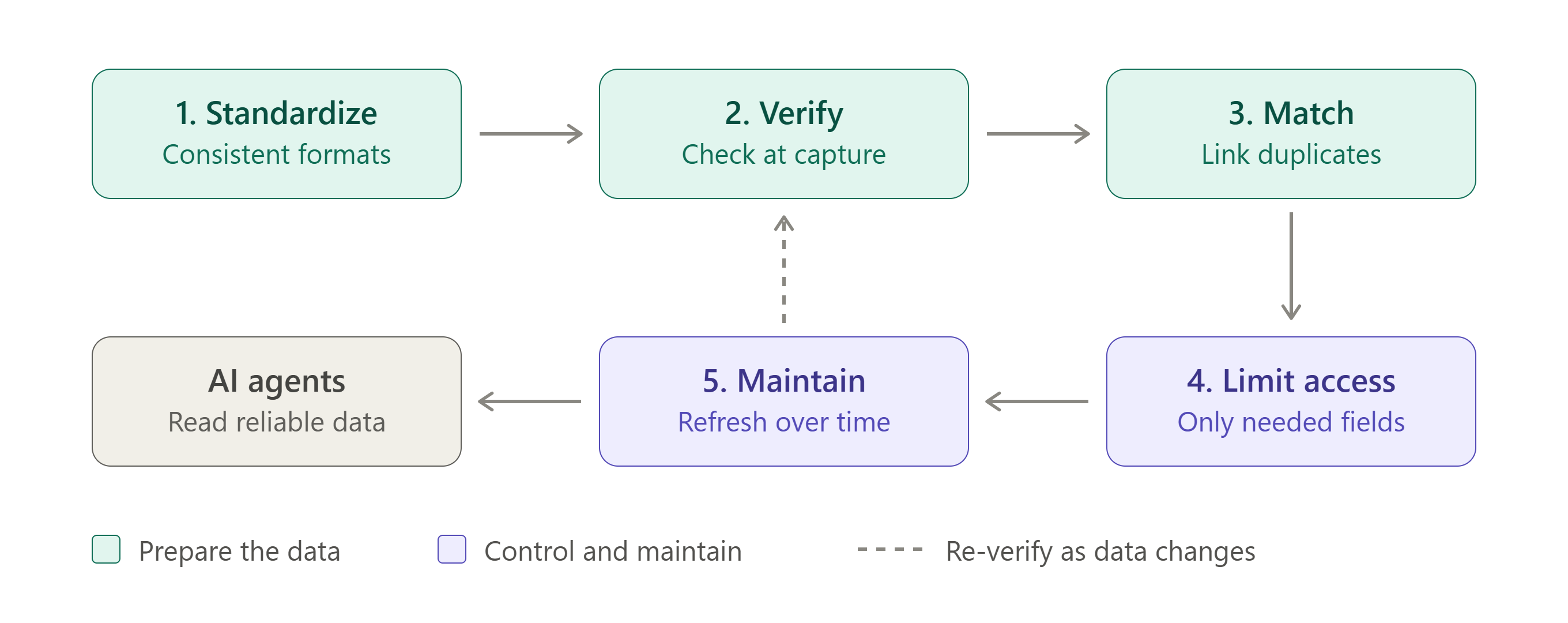
- Standardize before you connect. Apply consistent formats to names, addresses and phone numbers across systems before agents begin reading from them.
- Verify contact data at the point of capture. Checking addresses, phone numbers and email addresses as they are entered helps identify errors before they reach the systems agents rely on.
- Match and deduplicate records. Linking records that refer to the same customer gives agents a more complete picture and reduces conflicting actions.
- Define which data agents can use. Limit access to the fields each workflow needs and keep sensitive information out of scope where possible.
- Maintain data over time. Customers move, change numbers and update details. Periodic re-verification keeps agent workflows dependable as records age.
Why Clean Data Alone Cannot Make AI Agents Safe
Clean data does not make an agent safe on its own. Agents still need clear permissions, testing, monitoring and human oversight proportionate to the risk of the task. Accurate records will not prevent an agent from being configured poorly or given too much authority. Data quality removes one common source of avoidable error. It is a foundation, not a substitute for governance.
Start With Data Quality
The pace of AI adoption in the UAE makes readiness a practical question: what will our agents be reading, and can we trust it?
AI agents deliver value when the information behind their decisions is reliable. Accurate, standardized and verified customer data helps organizations reduce avoidable errors, support more dependable workflows and strengthen their governance processes. Explore how Melissa’s data quality and verification solutions can help prepare customer data for AI-driven operations.